Showing posts with label Apologetics. Show all posts

Monday, February 07, 2011

Future Prospects

I'm weird. I spend a lot of my free time talking and debating with other people about issues regarding philosophy and Christianity. It's different than witnessing to someone on the street; some of these people ask really hard questions. Then again, some people ask really stupid questions. Then again, some people ask really hard questions.

Here are some examples of questions that people are asking:
  • Why does God require people to have faith in his existence?
  • Why is it that Christians can willfully ignore Christ's commandment concerning adultery?
  •  Do you believe the story of Noah to be literal? Why?
  •  Why did you choose Christianity? Did you consider Judaism, Islam, Hindu, Shinto, any others, or none?
  • How is it decided which rules in the Bible can be broken without it being a sin [like homosexuality], and which rules must be followed in order to get into Heaven?
  • If the Bible is the word of God and the Bible tells women they need to be quiet in church, what justification is there for women like Joyce Meyer to not only speak in church, but to teach with authority?
  • Plus various questions about fee will, salvation, existence of heaven/hell and other questions.

Theres a lot of them and they ask the same hard questions over and over, in detail. So while I like answering people's objections to Christianity, I don't like repeating myself over and over and over and over and over. Maybe I'm just too lazy. In any event, I want to have a place where I can answer some of these hard questions and be able to copy/paste my answers.

Instead of hiding these questions/answers I figured it would be beneifical if I posted them in a public place. Hence this post. I think I am going to devote some of this spare time to building my own FAQ - Frequently Asked Questions so I can write responses, revise responses and build better arguments.

Stay tuned! I hope to develop it here on this blog.

Monday, April 12, 2010

Scoring Points for the Afterlife

This is something that I have been thinking about for a long time. It is something that I frequently encounter on the streets by Christians and non-Christians alike. Personally, I find it frightening that non-Christians think this way and even more frightened that Christians think this way too. What I am talking about is the idea that somehow we can work our way to Heaven. The thought that if we can do enough good things, they will somehow outweigh or cancel out the bad, horrible things that we have done here in our time on Earth.

I generally find that strong, mature Christians do not buy into this as much. However, it needs to be pointed out that this belief is completely false. It does not matter how many good things you do, you are still guilty. I think that part of the reason this is the case is because our culture in inundated with this thinking.

Take a portion from Weird Al's parody "Amish Paradise" for example. Read the lyrics below and you'll see what I mean.
Hitchin' up the buggy, churnin' lots of butter
Raised the barn on Monday, soon I'll raise another
Think you're really righteous? Think you're pure in heart?
Well, I know I'm a million times as humble as thou art
I'm the pious guy the little Amlettes wanna be like
On my knees day and night scorin' points for the afterlife

So don't be vain and don't be whiny
Or else, my brother, I might have to get medieval on your hiney
This song (although a parody) is a secular take at Christian life (albeit Amish) and this portion of quoted lyric is an example of how secular non-Christian people view salvation in Christ.

Paul addresses this clearly for us in Ephesians 2:8-9 where he writes, "For by grace you have been saved through faith, and that not of yourselves; it is the gift of God, not of works, lest anyone should boast."

When Paul is speaking of works in verse 9 he is specifically talking about the Jewish customs that one performed in service to God. Paul is writing the church at Ephesus so they know that they haven't been enabled to go to Heaven because they have completed certain religious achievements but because Christ's substitutionary death on the cross atoned for their sins. Just like Christ's death atoned for the sins of the Ephesians, it atones for our sins as well, today.

Christ will judge both the living and the dead (1 Peter 4:5) and the judgment is based on your standing with Him. Are you reconciled to Him or not? Are you forgiven of your sin or not? Are you adopted by the Father or not? Has your sin been removed from your account or not? Is your rap sheet clean or not?

To continue the thought of being judged consider this: You are standing before Christ, the judge, in His court of law. He has all the evidence you could ever want: eyewitness testimony, pictures, video, audio, he knows your thoughts and your heart while you did everything sinful. There is no question, you are guilty of the sin you have committed. You are about to be sentenced, the gavel is about to be slammed down but you object. You say, "Well, what if I can do more good things that will outweigh all of the crimes that I have been charged with?" Do you realize what you are doing? You are bribing the judge with your "good works."

You cannot bribe the judge (especially a judge who is completely good, righteous, just and will not compromise his ways)! If you bribe the judge it usually means you get thrown into prison quicker! This is all assuming that you could somehow outweigh the bad with good deeds.

This is why non-believers are hopelessly lost. If you are reading this and you aren't a Christian and you have thought this way, you need to realize your error. Your crimes aren't going to be erased because you set out to do "good things," not here on Earth and not later when you will be judged for those things.

So how can you stand before a Holy God and have any hope to enter into Heaven? You have to have your rap sheet wiped clean. You need to have your sins pardoned. You need to take your case to the cross.

God says that he "is longsuffering toward us, not willing that any should perish but that all should come to repentance." (2 Peter 3:9) God doesn't want his favorite creation to suffer an eternal death in Hell, separated from Him. He instead wants us to turn away from our sin and turn towards Him. God wants us to stop loving our sin, and start loving Himself. That is what repentance is.

Turn away from what is hindering you from following and loving God supremely and "if you confess with your mouth the Lord Jesus and believe in your heart that God has raised Him from the dead, you will be saved." (Romans 10:9)

The afterlife isn't based on "points" or a "grade." It is pass or fail.

Tuesday, February 09, 2010

3 Types of Apologetics

Classical Apologetics
General Characteristics:
- Stresses rational (logical) argumentation for the existence of God.
- It is necessary to demonstrate the existence of God first in order to argue for the resurrection of Jesus (God must exist for miracles to occur).
Adherents: Norman Geisler, William Lane Craig, R.C. Sproul, etc.
Scriptural Support: Romans 1:20 “For since the creation of the world His invisible attributes, His eternal power and divine nature, have been clearly seen, being understood through what has been made, so that they are without excuse.”

Evidential Apologetics
General Characteristics:
- They emphasize giving evidence for the Christian faith whether historical, logical, etc.
- They think miracles do not presuppose God’s existence, but can serve as evidence for His existence.
- Resurrection for example
Adherents: B.B. Warfield, John Warwick Montgomery, Gary Habermas, etc.
Scriptural Support: 1 Corinthians 15:3-7 “For I delivered to you 1as of first importance what I also received, that Christ died for our sins according to the Scriptures, and that He was buried, and that He was raised on the third day according to the Scriptures, and that He appeared to Cephas, then to the twelve. After that He appeared to more than five hundred brethren at one time, most of whom remain until now, but some have fallen asleep; then He appeared to James, then to all the apostles;”

Presuppositional Apologetics
General Characteristics:
- Emphasizes the importance of presuppositions (things you presuppose to be true) and/or the foundations of one’s thinking.
- Assumes the existence of God and the truth of the Bible.
- They would ask an Atheist for example: “How does your worldview account for logic? How can you make sense out of ethics, the dignity of man?” The Presuppositional approach seeks to uncover one’s presuppositions.
Adherents: John Frame, Greg Bahnsen, Cornelius Van Till, etc.
Scriptural Support: 2 Peter 3:5 “For when they maintain this, it escapes their notice that by the word of God the heavens existed long ago and the earth was formed out of water and by water,”

Monday, December 07, 2009

Differences Between New World Slavery and Greco-Roman Slavery

I'm not talking about the New World Translation, but the slavery that existed when America (the New World) was first founded.

There are many errors in interpretation that happens when we read of slavery in Paul's letters and attribute the slavery of a few hundred years ago. Slavery was tremendously different from these two different periods of history. When you get asked why Paul speaks of slaves obeying their masters instead of fleeing their cruelty you will be able to explain the differences between these different eras of slavery:

New World Slavery vs. Greco-Roman Slavery

1a. Slavery was a permanent condition, a "life sentence" with no hope of freedom.
1b. Unless a criminal, a slave had every hope of emancipation - usually after a 10 to 20 year condition after reaching adulthood.

2a. Slavery was racially delineated: Negro slaves, white masters.
2b. Impossible to distinguish a slave on the basis of color, clothing or race.

3a. Slaves were segregated socially.
3b. Usually unable to distinguish a slave from others by friends, occupation or worship patterns. As a tentmaker Paul probably worked alongside slaves, who could join the same clubs as freed people and free people.

4a. Slaves had no legal rights.
4b. Slaves had many legal rights, including the right of appeal to a higher authority in the case of unfair treatment.

5a. Slavery was the lowest rung of society.
5b. Slaves were often of higher status than the free, depending on who their masters were. A slave of Caesar, the largest slave owner by far, could command significant power and prestige. From this high status, there was a continuum down to the very lowest rung of society.

6a. Slavery was degrading and dehumanizing.
6b. Slavery was viewed as an opportunity. Large numbers of persons sold themselves into slavery to find a better life than they had as free people and to secure special jobs and to climb socially.

7a. Slaves were confined to menial work.
7b. Slaves held high positions in civil service and in the business world. Attended their owners as doctors and nurses, taught and advised their young owners and acted as companions and protectors to elderly owners. were writers, accountants, bailiffs, overseers, secretaries and sea captains. For example, Marcus Antonius Felix, the Judean procurator who judged Paul (Acts 23:23 - 24:27). was a freed person of Claudius's mother, Antonia.

8a.Illegal to educate slaves.
8b. Slaves often highly educated, acting as tutors and advisers for their owners.

9a. Slaves not able to own property.
9b. Slaves could own property, could maintain savings for the day of their manumission (emancipation/freedom) and even owned their own slaves.

10a. The slaves had no hope of normal family life.
10b. Slaves often maintained a separate existence from their masters, even holding down outside work to increase their savings.

11a. Slavery was wholly detestable, as a result of kidnapping.
11b. Slavery was often preferred and chosen. Manumission was frequently a disadvantage for the slave and financially advantageous for the master.

Unlike the New World slaves, the Greco-Roman slaves could realistically expect faithful service to be rewarded with freedom and concomitant Roman citizenship, usually within 10 to 20 years after achieving adulthood.

Now you can know what Paul meant when he wrote about slavery like in passages like 1 Corinthians 7:22 - "For he who is called in the Lord while a slave is the Lord’s freedman. Likewise he who is called while free is Christ’s slave."


\\ Ephesians 4:11-12 \\ For The Equipping of the Saints.

------------------
Source: The Problem with Paul. Author: Brian J. Dodd

5 Things that Can't Be Proven By Science, but are still Rational to accept

To watch the video of this, Click on this and watch William Lane Craig own this guy in a 1998 debate. Skip to 1:10. This is what he said:


1. Logic and Mathematics

Science presupposes Math and Science, Science cannot prove these things, but everyone accepts them as truth.

2. Metaphysical truths

The concept there are other minds other than your own, or that the past was not created 5 minutes ago with an appearance of age cannot be proven/disproven by science.

3. Ethical beliefs

You cant show by science whether the Nazi scientists did anything worse than the American scientists in WWII or otherwise.

4. Aesthetic judgments

The beautiful, like the good cannot be scientifically tested.

5. Science itself

Science itself cannot be justified by the scientific method that would be circular reasoning.


-William Lane Craig

Science isn't the end all be all. Don't fear Science, Fear God.

Psalm 27:4
One thing I have desired of the LORD,
That will I seek:
That I may dwell in the house of the LORD
All the days of my life,
To behold the beauty of the LORD,
And to inquire in His temple.

Monday, January 19, 2009

Let My People Think


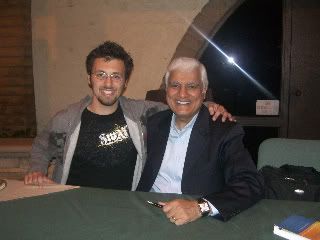
So earlier this Friday KC, Michelle, John and Aaron and myself had the blessing to go see Ravi Zacharias. There are only a few people in the Christian circles that I really look up to and Ravi Zacharias is one of them. He has a radio broadcast called "Let my People Think" and is available for download from iTunes for your listening edification.

So Friday I was very excited to see him in person and hear him teach. The topic of his message was "Need God? What if I don't?" He never opened his Bible but there wasn't anything he said that I remember doubting that it had its roots in right doctrine.

He also had some great quotes, for example:

"The New Atheists are better at smelling rotten eggs than laying good ones."

"Jesus answered the man's question, "Who's image is on the coin?" They replied 'Caesar's.' Jesus said give to Caesar what is Caesar's and give to God what is God's. (Matt 22) What image is on you?" (Imago Dei)

"This generation listens with their eyes and thinks with their hearts."


Such a blessing to hear this man speak with such fervor and tenacity. He was kind enough to let KC and I take pictures with him without getting a book signed. :)

Sunday, January 11, 2009

Argument against Literal Communion Elements

So I was spending time with the Lord this morning and I opened up today's entry to Jon Courson's devotional A Day's Journey and he made a really good argument against the Catholic belief surrounding communion.

According to the Catholic doctrine of Transubstantiaion the bread and the wine actually transform into the actual material blood and body of Christ. Personally I do not believe this and I think there are a number of great arguments against it. However, in this blog I will detail only one of them.

This isn't the only time people have confused Christ's words for something material when they were supposed to be spiritual. Jon Courson writes:
In John 3, Jesus said, "You must be born again."

"How does a man enter into his mother's womb the second time?" asked Nicodemus. Jesus was speaking spiritually, but Nicodemus was trying to figure it out physically.

In John 4, Jesus said, "I have water to give you which if you drink you shall never thirst again."

"Give me this water," said the woman at the well, "so I won't have to keep drawing water from the well." She was thinking materially, but Jesus was speaking about the water of the Spirit internally.

In John 6, Jesus said, "Unless you eat of My body and drink of My blood, you can have no part of Me."

The crowds, thinking He was talking about cannabalism, began to turn away from Him. Again, He was speaking of the spiritual realm, but the people couldn't see past the material realm.

This seems to be our nature to generally not comprehend what Jesus is talking about unless the Holy Spirit tells us.